Bed-Stuy
Brooklyn's soul — and in 2026, its most contested market.

The Market Right Now
If Williamsburg is the brand and Clinton Hill is the aspirant, Bed-Stuy is the soul. In 2026 it remains the primary battlefield for what I'd call the End-User vs. Investor war — and unlike some Brooklyn neighborhoods where that tension has resolved in one direction, Bed-Stuy is still genuinely up for grabs in a way that creates both opportunity and risk depending on which side you're on.
The value narrative is still alive but it's more nuanced than the headline number suggests. The $1.6M baseline I reference for prime Bed-Stuy is the entry point for a two-family frame house or a brownstone needing a gut-lite renovation. A pristine 20-foot-wide brownstone on a landmarked block like MacDonough Street is hitting $2.4M to $2.8M in 2026. The neighborhood has a ceiling now. It's just higher than most people outside of it realize.
The velocity story is being driven almost entirely by multi-family dynamics. Renovated three and four-family houses are moving in a weekend because in 2026 the rental income offset is the only way most buyers can make the mortgage math work. If the garden unit fetches $3,500 a month, the house sells fast. That's the Bed-Stuy buying logic right now and it's reshaping which product moves and which sits.
What's sitting: over-leveraged luxury condos on the Bedford corridor without outdoor space. In 2026 if you're buying a condo in Bed-Stuy, you need a balcony or a roof deck. Without it you're paying a premium for something that competes directly with rentals and loses.
Ocean Hill North: The 2026 Value Play

Most buyers still write off Ocean Hill. The blocks between Rockaway Avenue and Broadway Junction are where the smart 2026 money is moving.
The city's investment in the Broadway Junction Transit Hub is finally underway and the speculative heat hitting this pocket right now mirrors what Clinton Hill looked like in 2015. You can still find a townhouse here under $1.4M — a unicorn price in today's Brooklyn that won't exist for much longer. For buyers with a five-plus year horizon who understand what transit infrastructure investment does to residential values, this is the conversation to have before everyone else is having it.


The Tompkins Divide: Two Bed-Stuys
Buyers in 2026 navigate the Tompkins Avenue line with surgical precision and the difference matters enough to treat them as two separate searches.
West of Tompkins is the Clinton Hill bleed — denser, more condo-heavy, closer to the G train, and more renter-heavy in feel. Buyers here are often coming from Williamsburg or Crown Heights and want proximity to the Franklin Avenue corridor without the Franklin Avenue price point. It's a neighborhood in active transition and the housing stock reflects that mix.
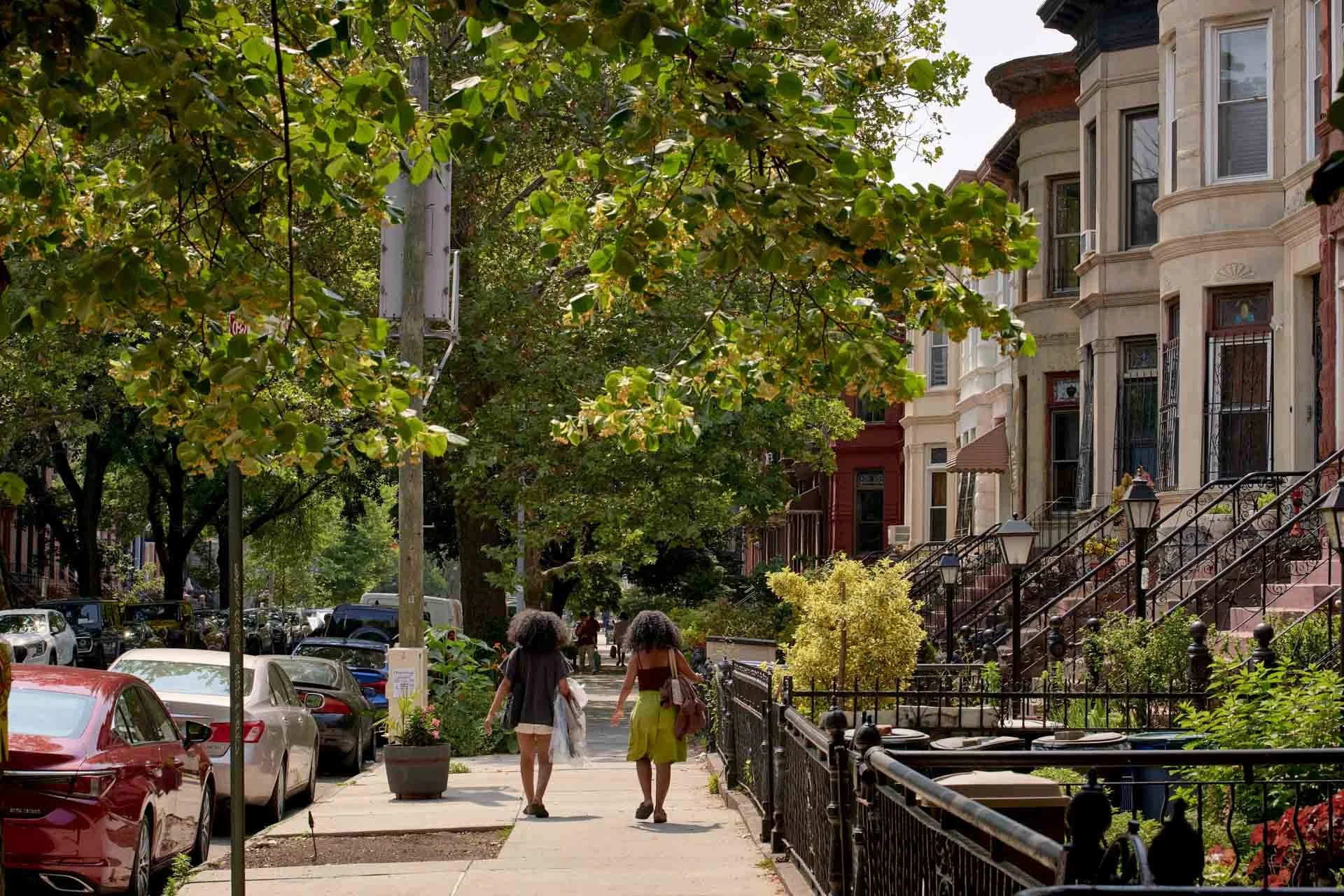
East of Tompkins — Stuyvesant Heights — is where the architectural story lives. The high-stoop brownstones, the landmarked blocks, the block association culture that defines what Bed-Stuy actually means to the people who've been here longest. People moving east of Tompkins aren't looking for a three-year starter home. They're looking for a ten-year anchor and they're making that decision deliberately.
If you're a buyer and you haven't clarified which Bed-Stuy you're actually looking for, you haven't started your search yet. That's the conversation I want to have before we look at a single listing.
The Cultural Fabric
Crown Heights has one of the most layered neighborhood identities in Brooklyn and I think it's worth saying directly: this is a neighborhood with genuine community roots that predate the recent real estate attention by decades. The institutions here — the libraries, the community centers, the commercial strips along Nostrand and Utica — reflect that history and they're part of what makes the neighborhood function as a real place rather than just a real estate market.
What's happening on the commercial side in 2026 is genuinely exciting. Spots like Ras Plant Based and Brooklyn Suya aren't gentrified versions of the neighborhood's cultural identity — they're the next generation of that identity, higher-end concepts built by people with deep roots in the diaspora communities that have defined this neighborhood for generations. That distinction matters and it's visible if you spend time on the blocks.
The Transit Logic
Bed-Stuy's transit coverage creates two completely different daily life experiences and knowing which one fits your commute is foundational to where you look.
The A/C Corridor — South Bed-Stuy is the professional lifeline. If your commute is FiDi or Midtown, you want to be within six blocks of Nostrand or Utica. The A express is the neighborhood's most valuable amenity in 2026 and pricing reflects proximity to it.
The J/Z Corridor — North Bed-Stuy/Broadway connects to the L at Broadway Junction and heads into the Lower East Side, which has made this pocket the creative spillover zone from Bushwick. The blocks here are louder and more active in feel, with a community that prioritizes access to art spaces and nightlife over quiet residential streets. It's a distinct lifestyle choice and the right one for the right buyer — just not one to stumble into by accident.
The G Train upgrade effect — the CBTC signal upgrades completed in 2026 have made the Bedford-Nostrand G stop a viable Manhattan commute via L and 7 transfers in a way it genuinely wasn't before. This has pushed prices up roughly 10% on the Lafayette/DeKalb corridor in the past year alone. If you were looking at this pocket two years ago and got scared off by the G train reputation, the math has changed.
Ground-Level Intel
The Investor Flip Warning — a significant percentage of Bed-Stuy inventory in 2026 is investor flips from 2023 and 2024, and the quality varies enormously. The tell: look at the mechanicals, not the finishes. Many investors spent money on waterfall islands and black hardware while keeping a 40-year-old boiler. When I'm evaluating a renovated Bed-Stuy brownstone I check the depth of the joists in the cellar. If they didn't sister the beams during the renovation, the floors will be sagging by 2028. A beautiful kitchen does not mean a sound building. Know the difference before you fall in love with the staging.
The Block Association Reality — Bed-Stuy has the most powerful block associations in Brooklyn and if you buy on a serious block you're not just buying a home, you're joining a community with expectations. Blocks that have won the Greenest Block in Brooklyn competition — Stuyvesant Avenue is the benchmark — operate with genuine collective standards. You will be expected to sweep your sidewalk, maintain your facade, and show up to the block party. For the right buyer that's a feature, not a burden. For the wrong buyer it's a surprise they wish someone had mentioned earlier.
The Saraghina Saturday Test — you don't know Bed-Stuy until you've stood in line at Saraghina Bakery on a Saturday morning. If a client asks me about the neighborhood vibe I tell them to spend two hours on the corner of Halsey and Tompkins. If they don't like what they feel there, they won't like the neighborhood. It's the most honest neighborhood preview available and it costs nothing.
The MacDonough Street Premium — landmarked blocks in Stuyvesant Heights command a real premium and it's worth understanding why before you negotiate against it. The landmark designation means the architectural character of the block is protected — your neighbors can't put vinyl siding on a brownstone, can't alter the facade without approval, can't do the things that erode block value over time. You're paying for permanence and it's a legitimate thing to pay for.
The Multi-Family Math — if you're buying a two, three, or four-family home in Bed-Stuy, underwrite it as an investment from day one even if you plan to live in it. Know what the rental units can realistically fetch, what the carrying costs look like with and without that income, and what the exit looks like if your situation changes. The buyers who get in trouble here are the ones who buy based on the owner-occupied fantasy and discover the reality of being a landlord after they've closed.


What I'm Seeing on the Ground
Bed-Stuy is one of the few Brooklyn markets where the difference between a great outcome and a costly mistake comes down almost entirely to preparation and knowledge. The investor flip market, the block association culture, the Tompkins divide, the transit logic — none of it shows up in a listing description. If you're serious about Bed-Stuy I want to walk you through it before you start making offers, not after you've already committed to the wrong block for your situation.
Thinking about Bed-Stuy? Let's talk.
I know this neighborhood and I'll give you a straight read on whether it fits what you're looking for — no pitch, no pressure.