DUMBO
The neighborhood I learned this business in — and one that still surprises me.
A Personal Note
I started my real estate career on these blocks. When I was working my first leads out of an office on Front Street, grabbing lunch at Peas and Pickles on 55 Washington before sprinting over to show a unit at 220 Water, the Empire Stores was just a vacant, hauntingly beautiful shell. Watching it become a global design and tech anchor — block by block, deal by deal — is a transformation I didn't just read about. I was here for it.
That history informs everything I know about this neighborhood. DUMBO isn't a market I studied. It's a market I grew up in professionally, and the perspective that comes from that is something no listing description can replicate.

The Market Right Now
The 2026 DUMBO story is one of aggressive stability. The frantic bidding wars of the post-pandemic era have cooled into what I'd call a selective luxury phase — and that distinction matters for how you approach this market.
Median sales are hovering around $2.2M with a price per square foot north of $1,700, making DUMBO one of the most expensive zip codes in the city. What drives that isn't prestige for its own sake — it's genuine scarcity. You cannot manufacture 19th-century timber-and-beam lofts with protected park views anywhere else in New York. The inventory that exists is what exists, and it's not being replicated.
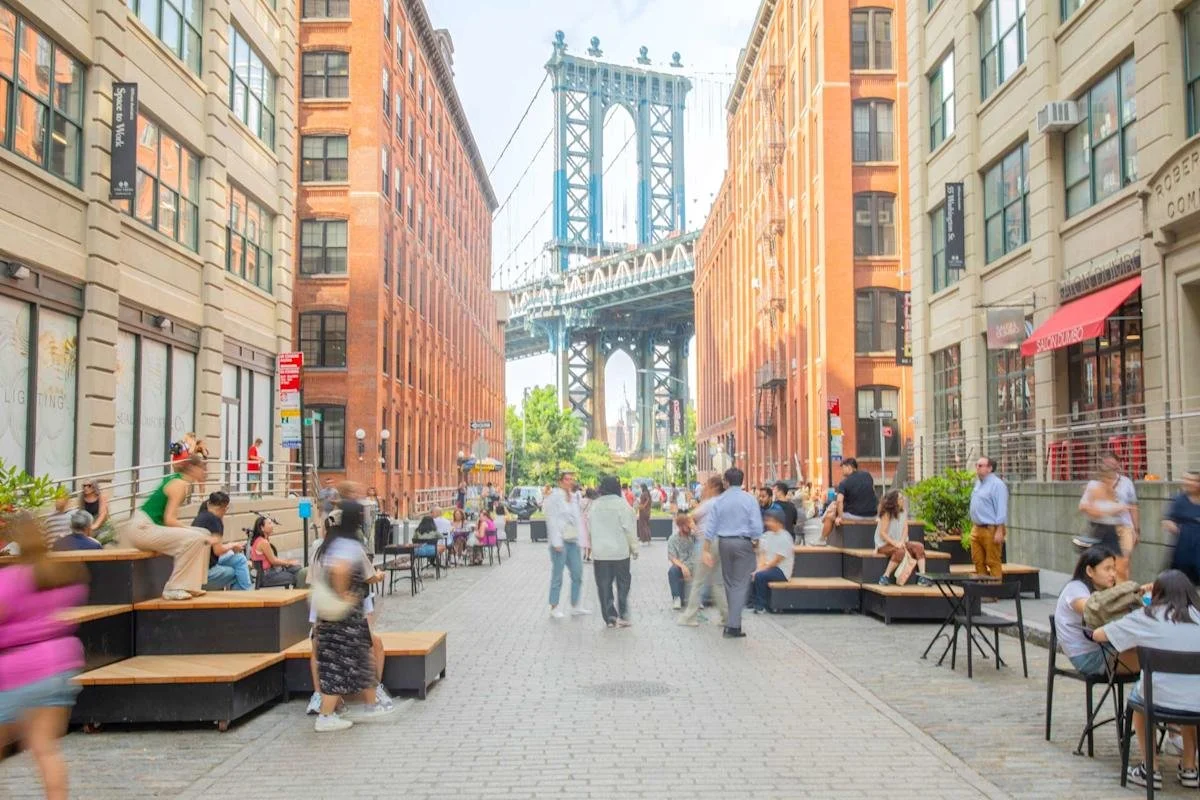
Speed varies significantly by product. Turnkey high-floor lofts with Manhattan Bridge views at buildings like 70 Washington and 60 Water are gone in under 20 days. Ground-floor units with limited light or no direct outdoor access are sitting longer as buyers in this price range have become more demanding about exactly what they're paying for. If you're a seller, condition and light are everything. If you're a buyer, the units that linger are worth a second look — but only with the right guidance on why they're sitting.
The Vinegar Hill Border: The 2026 Value Play

Everyone fights for the blocks between the bridges. The smarter play in 2026 is the corridor drifting east toward Vinegar Hill — Water Street moving toward Gold Street — where the shoe-factory conversion at 220 Water Street anchors a pocket that offers more square footage for the dollar and a quieter, more residential feel than the tourist-heavy Washington Street corridor.
This is old Brooklyn in the best sense. Less foot traffic, more authentic neighborhood energy, and pricing that still reflects the fact that most buyers stop their search before they get here. For buyers who want the DUMBO address and loft aesthetic without the premium of the most trafficked blocks, this is the conversation I want to have before you start touring.


Who's Moving Here
DUMBO has evolved from a tech hub into what I'd call a Design and Lifestyle District. The draw in 2026 isn't the cool factor — that's been established for two decades. It's the scale. You have 85 acres of Brooklyn Bridge Park as your front yard and a neighborhood that spans roughly 25 blocks. It feels like a private campus in a city that doesn't do private campuses.
The people choosing DUMBO over Williamsburg or Manhattan are making a specific calculation. Creative and tech professionals who want to walk to their office at 20 Jay or 45 Main. People who want the true loft aesthetic that no longer exists in SoHo or Tribeca at any reasonable price point. And a consistent wave of Manhattan arrivals who've done the math and realized what DUMBO offers relative to what the same money buys across the bridge.
Ground-Level Intel
The Building Hierarchy — Two Trees, the Walentas family operation, essentially built this neighborhood and their inventory remains the gold standard for management and quality. 25, 30, 65, and 81 Washington are the benchmark. If you want ultra-modern, 60 Water is the play. If you want the original 14-foot timber-beam aesthetic — the thing people mean when they say DUMBO loft — 220 Water Street is still the champion of that category. I know these buildings well. There's a difference between reading about them and having worked their inventory firsthand.
The Parking Reality — it's a serious consideration in DUMBO in a way that it isn't in most Brooklyn neighborhoods. Street parking is genuinely difficult and the neighborhood's density makes it worse than it looks on a map. If a unit at 55 Washington comes with a deeded parking spot, that spot adds $150,000 or more in effective value. Factor it into your analysis from the beginning, not as an afterthought.
The Bridge Hum — this is the thing most agents don't mention until after you've signed. If you're in a high-floor unit on the west side of a building, you aren't just hearing the bridge — you're feeling it. It's a constant low hum that some people tune out completely and others find difficult to live with. Come back on a weekday afternoon before you make any decisions on a west-facing high-floor unit.
The Transit Reality — the York Street F station handles more foot traffic than it was built for and in 2026 the congestion is at an all-time high. What I tell every client who asks about the commute: if you can, use the NYC Ferry from Fulton Ferry Landing. It's the most civilized commute in the city — quiet, reliable, and it puts you in Manhattan without the platform chaos. Once you've done it a few times it becomes the only way you want to travel.
The Dining Anchors — Almar is still the neighborhood's soul and has been since before most of the current residents arrived. Time Out Market in Empire Stores has become the go-to for quick lunches and client meetings — and it's worth knowing that the Empire Stores itself, that hauntingly beautiful vacant shell I used to walk past on my way to showings, is now one of the most thoughtfully developed commercial spaces in Brooklyn. The transformation is worth seeing even if you're not buying.


What I'm Seeing on the Ground
DUMBO rewards buyers who understand what they're actually paying for — and penalizes those who don't. The difference between a unit that's worth every dollar and one that's sitting for a reason is often something you can only see if you know the buildings and the blocks the way I do. If you're serious about DUMBO I'd rather walk you through it in person than explain it in a listing description.
Thinking about DUMBO? Let's talk.
I know this neighborhood and I'll give you a straight read on whether it fits what you're looking for — no pitch, no pressure.